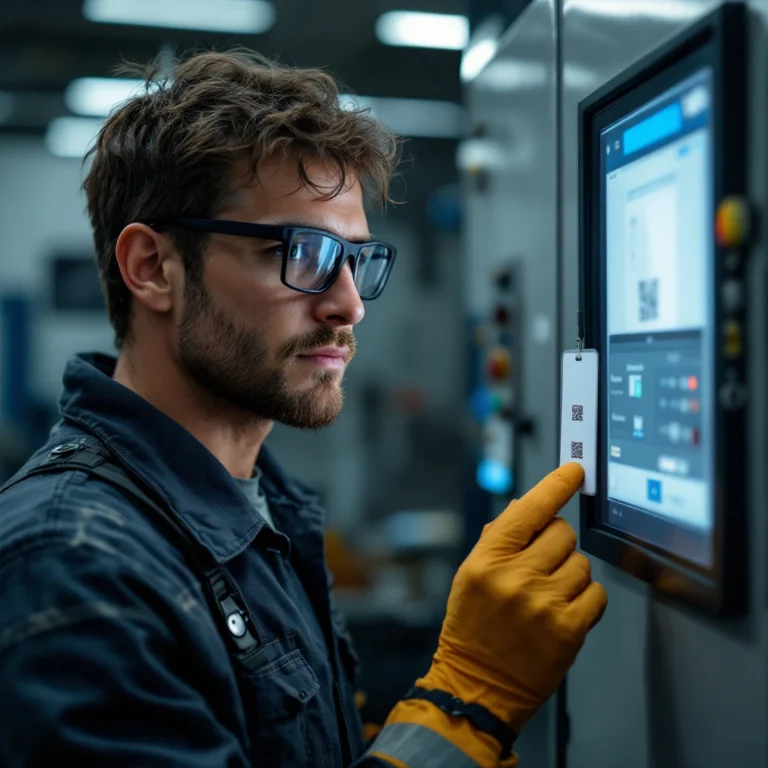
In an industrial environment, your badges aren’t just carried; they’re bathed in a cocktail of sanitizers, degreasers, lubricants, acids, solvents, and the occasional accidental dip in a pail of cleaning solution because someone forgot to take their lanyard off.
If the badge isn’t built to shrug off that abuse, you’re basically running a “pay us to replace these every three months” program without even signing up for it.
The Silent Assassin in Your Facility
It’s no exaggeration to say that chemicals are the number one cause of industrial ID badge failures. Not dropping them or running over them with a forklift. Chemicals. Specifically:
- Industrial Cleaners and Degreasers: The heavy-duty stuff that takes grease off engine parts is also fantastic at lifting the printed layer off a standard PVC card.
- Hand Sanitizer and Alcohol Wipes: Thanks to infection control protocols, your healthcare and manufacturing badges get wiped down constantly. A surface-printed barcode survives that for maybe a month.
- Cutting Fluids and Coolants: As a machinist or CNC operator leans over their work, their badge hangs right in the mist zone. The edges start to separate; the plastic bubbles like bad wallpaper.
- Oils, Fuels, and Solvents: In auto shops, refineries, and mills, these migrate onto the badge and work their way under the laminate if there’s even a hairline gap at the edge.
The Result?
The result isn’t just aesthetic. Once a barcode or QR code degrades, scan attempts fail. Also, when scans fail, people revert to manual workarounds like clipboard sign-ins, verbal check-offs, and the dreaded “just wave him through,” which unravel your access control, time tracking, and safety accountability in the time it takes to say “beep error.”
We talked about how hidden workflow friction kills productivity in our deep dive on manual friction and badge design, and the chemical battlefield is one of the biggest sources of friction in the game.
Where Chemicals Strike First (Spoiler: It’s the Barcode)
The barcode or QR code on your badge is the most vulnerable real estate. Print it on the surface of a card, and every swipe of a sanitizer wipe slowly erases it — not instantly, but through a process called chemical etching where the solvent breaks down the ink’s adhesion to the PVC. A code that scanned in 0.3 seconds suddenly takes four attempts, then ten, then becomes a paperweight on a lanyard.
Even worse: many industrial facilities use laminated cards in which the laminate sheet covers only the middle of the card, leaving a tiny unsealed rim around the edges. That rim is like an open door. One splash of degreaser seeps under the laminate, and within days you’ve got a bubbled, peeling mess that looks like your badge has a skin condition.
The Edge-to-Edge Difference
The only way to truly make a chemically-resistant ID badge is to seal it completely — edge to edge, no seams, no gaps, no scope for a solvent to find a microscopic crack and start house-hunting.
That’s exactly what retransfer printing with a continuous overlay does. Instead of printing directly onto the card surface (which essentially bakes the image onto the outermost layer, vulnerable as all get-out), retransfer technology prints onto a clear film and then thermally bonds that entire film to the card core under heat and pressure.
The overlay covers the entire card, including the edges, creating a monolithic seal. No exposed ink or raw plastic peeking through. No pathway for a degreaser to slide underneath and ruin your Friday.
At abc identity SOLUTIONS, every badge we produce uses this retransfer process. It’s not a premium upsell; it’s the standard because we know the environments our badges will be in. We just build the best badge for the job and ship it to your door.
Vertical Design: The Unsung Hero of Harsh Environments
Why are we always singing the praises of vertical badge orientation? Lanyard-worn cards naturally hang with the short end up, and a vertical layout places your QR code at the bottom, where gravity keeps it steady and forward-facing. That means less handling, less flipping, less rubbing, and fewer opportunities for chemicals on a worker’s gloves to migrate onto the scanning surface.
Combine that with a retransfer overlay that shrugs off iso-wipes and industrial cleaners alike, and you’ve got a chemically-resistant ID badge that scans instantly on every pass through a doorway, time clock, or inventory station even if it’s spent eight hours marinating in a cocktail of vaporized coolant and break-room coffee fumes.
This design reduces manual data entry, ends the clipboard shuffle, and keeps your time & attendance and access logs so clean they’d make an auditor weep with joy. That’s particularly important for Canadian facilities governed by PIPEDA, PHIPA, or provincial occupational health and safety regulations, where accurate identity verification and access records aren’t a “nice to have”; they’re a legal obligation.
Why In-House Printing Can’t Match This (Without Driving Someone Nuts)
It’s tempting to think, “We’ll just buy a printer and do it ourselves.” It’s like saying, “We’ll just buy a pizza oven so we never have to order delivery again.”
Sure, it’s possible, but suddenly you’re the one maintaining the ribbon tension, ordering the right overlay packs, troubleshooting when the printhead leaves a ghost streak across every card, and explaining to the safety manager why the badges look like they’ve been through a blender after six weeks.
Even if you nail the printing, a standard in-house setup rarely delivers true edge-to-edge sealing. You end up with cards that look good on day one and start failing by day ninety. That’s not a solution — it’s a deferred headache with interest.
We print the badges. You wear them. That’s the entire arrangement. No printer in your office, supply closet full of mystery ribbon rolls, or desperate call to tech support while a whole shift can’t clock in. Just cards that arrive ready to hang, scan, and survive whatever your facility throws at them.
Ready to End the Chemical War on Your Badges?
You don’t need a chemistry degree to know that a badge that can’t survive your environment isn’t really a chemically resistant ID badge. It’s a recurring expense and a security gap when wearing a lanyard. The fix is easier than you think: edge-to-edge sealed cards built for exactly the abuse your team dishes out, printed and shipped across Canada without you ever having to touch a machine.
If your badges are currently melting, fading, or peeling, let’s fix that before your next compliance audit gives you gray hair.
Grab a no‑pressure spot on the calendar: www.abcidentity.ca/booking-site
Or drop us a line: info@www.abcidentity.ca
Prefer a quick chat? Call: 204‑813‑0054